📝 Editor's Note
When Hubble announced water vapor in K2-18b's atmosphere in 2019, I went straight to the original paper. Hubble launched in 1990 — a nearly 30-year-old 'old telescope' still making groundbreaking discoveries. That's genuinely impressive.
— Admin
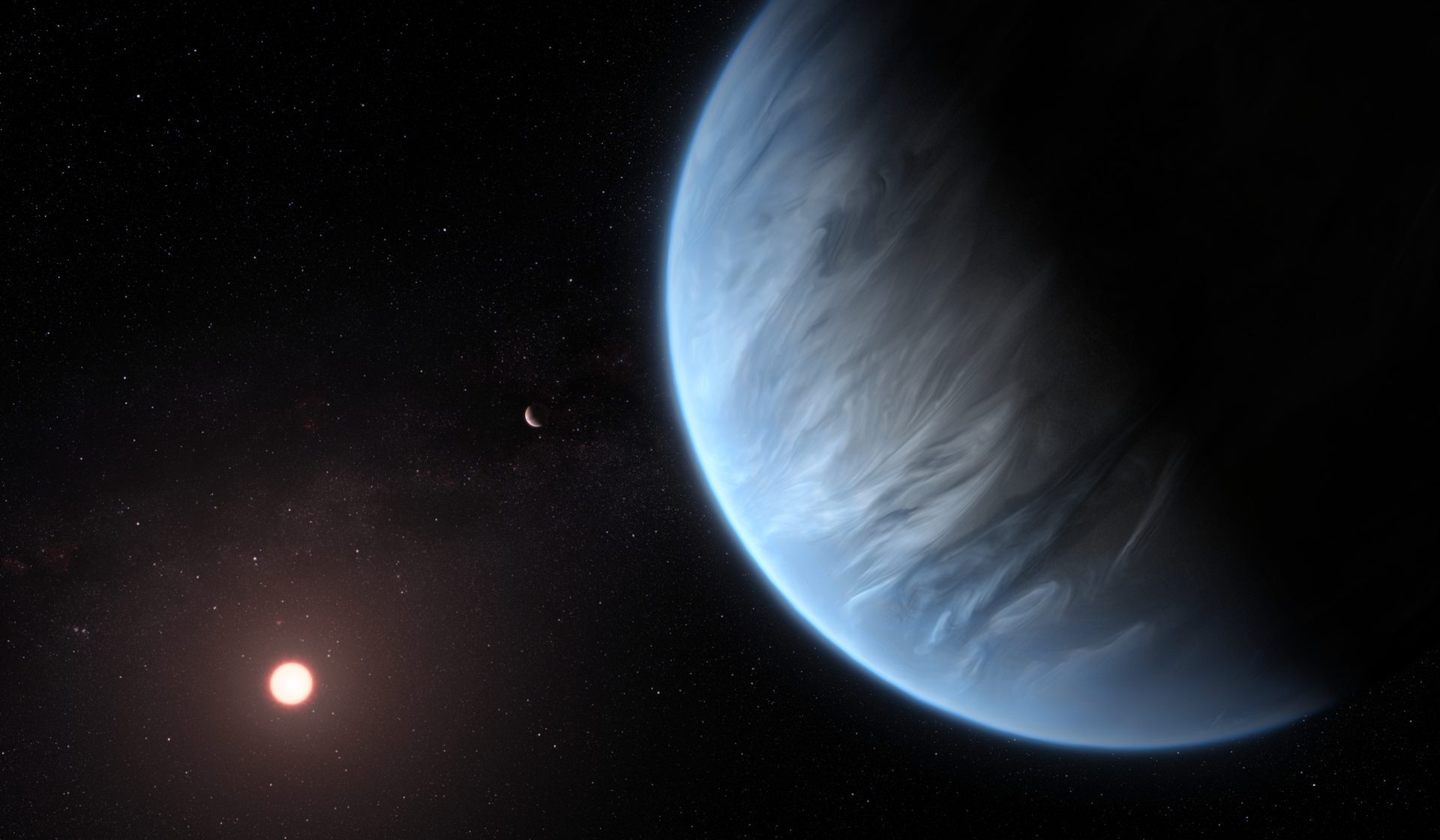
In September 2019, an international team of astronomers led by University College London published a groundbreaking paper in Nature Astronomy: using data from the Hubble Space Telescope, they had found conclusive evidence of water vapor in the atmosphere of K2-18b. This marked the first time water had been detected in the atmosphere of a planet in the habitable zone.
Hubble's Unique Capabilities
Although not designed specifically for exoplanet research, Hubble's Wide Field Camera 3 (WFC3) has a unique capability in its infrared grism mode. When a planet transits its star, a tiny fraction of starlight passes through the planet's upper atmosphere before reaching Earth. Molecules in the atmosphere absorb specific wavelengths of light, leaving "fingerprints" in the spectrum — and water molecules have a strong absorption feature near 1.4 microns, right within WFC3's range.
Challenges and Breakthroughs
Observing K2-18b's atmosphere was extremely challenging. Although K2-18 is relatively bright for a red dwarf, capturing such faint signals from 124 light-years away required extraordinary precision. The team used eight transit observations from Hubble's WFC3, conducted in 2016 and 2017, totaling dozens of hours of observation time.
Stacking all eight transit datasets produced a spectrum with sufficient signal-to-noise ratio. Analysis revealed clear water absorption features in the 1.15 to 1.65 micron range. Atmospheric models including water vapor fit the data many times better than models without water.
Scientific Significance
This discovery was monumental because K2-18b was the first known planet in the habitable zone with a water-bearing atmosphere that could be studied in detail. While water had been detected in hotter, larger planets (like hot Jupiters), K2-18b's size (2.6 Earth radii) and mass (8.6 Earth masses) are much closer to Earth's, and it resides in the habitable zone.
The Hubble findings also suggested that K2-18b might have relatively low clouds or gaps in its cloud cover, allowing signals from deeper atmospheric layers to be detected. This was encouraging for JWST, which could probe even deeper for more complex molecules.
The 2019 discovery not only confirmed water vapor in K2-18b's atmosphere but also paved the way for JWST follow-up observations. It proved that characterizing the atmospheres of temperate exoplanets around red dwarfs is entirely feasible, opening a new era in exoplanet atmospheric science.