📝 Editor's Note
I was still in college when I first saw the news about K2-18b's discovery in 2015. Back then, the phrase 'habitable zone' felt almost romantic. Years later, this planet keeps surprising us.
— Admin
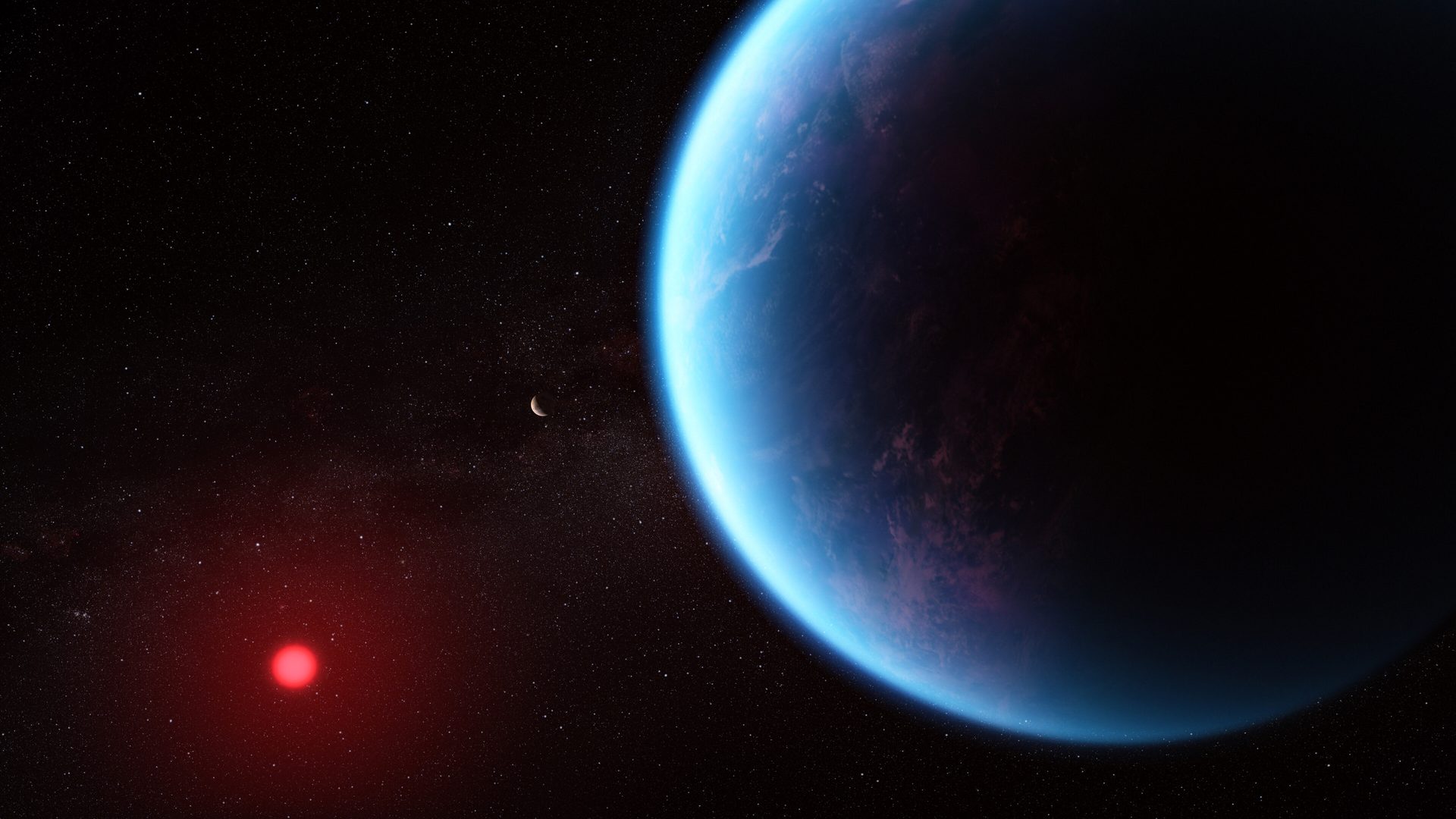
In 2015, astronomers analyzing data from Kepler's K2 mission identified a fascinating planet in the constellation Cancer, about 124 light-years away — K2-18b (also designated EPIC 201912552 b). Orbiting a red dwarf star called K2-18, this planet immediately captured the attention of the international astronomical community.
K2-18: A Temperate Red Host Star
K2-18 is an M-type red dwarf, with about 0.41 times the mass of the Sun, 0.41 times its radius, and a surface temperature of approximately 3,500 K. Compared to our Sun, this star is dimmer, cooler, and has a vastly longer lifespan — red dwarfs can remain stable for trillions of years, providing ample time for life to potentially develop on orbiting planets.
K2-18's relative brightness makes it an ideal target for atmospheric follow-up studies. With an apparent magnitude of about 13.5, it is invisible to the naked eye but bright enough for instruments like the Hubble and James Webb Space Telescopes to perform spectroscopic analysis.
Planetary Parameters
By analyzing the transit light curve and subsequent radial velocity measurements, astronomers determined K2-18b's key parameters: a radius about 2.6 times Earth's, and a mass about 8.6 times Earth's. These parameters place K2-18b in the "sub-Neptune" category — a class of planets between Earth and Neptune in size, characterized by a rocky core enveloped in a thick hydrogen-helium atmosphere.
K2-18b orbits its star every 33 days at a distance of about 0.14 AU (21 million km). Because its host star is much dimmer than the Sun, this orbital distance places the planet squarely within the habitable zone — the region where temperatures could allow liquid water to exist.
A Special World in the Habitable Zone
What makes K2-18b so remarkable is its combination of properties: it is the first planet in the habitable zone with a size between Earth and Neptune orbiting a relatively bright star. This unique combination enables detailed atmospheric spectroscopic analysis using Hubble and JWST.
K2-18b opened a new door in exoplanetary science. It is not merely a milestone in humanity's exploration of other worlds, but a scientific treasure that continues to captivate astronomers worldwide. Its discovery set in motion a chain of observations that would ultimately lead to the most tantalizing hints of extraterrestrial biosignatures ever detected.