📝 Editor's Note
I stayed up all night watching the JWST launch live. Ten billion dollars, 25 years of development, countless delays… when the rocket finally separated successfully, everyone in mission control was in tears. I'm not a scientist, but that night, I cried too.
— Admin
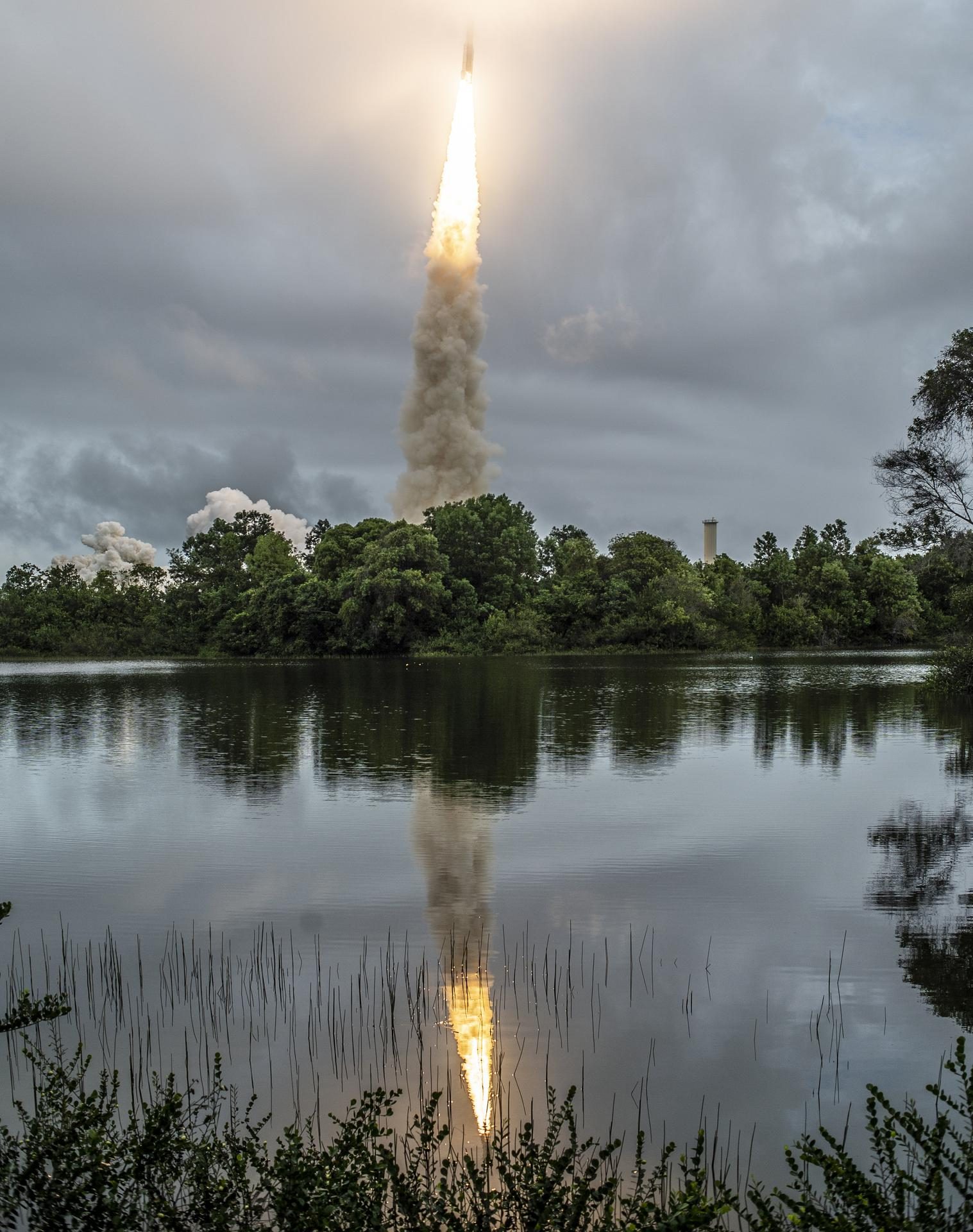
On Christmas Day 2021, an Ariane 5 rocket thundered skyward from the Guiana Space Centre in Kourou, French Guiana, carrying what astronomers had been waiting for — the James Webb Space Telescope (JWST). The most complex and powerful space observatory ever built, with a price tag of approximately $10 billion and over 20 years of development, Webb finally began its journey to the second Lagrange point.
The Impossible Deployment
JWST's design represents an engineering marvel. To achieve unprecedented sensitivity, it needed a 6.5-meter primary mirror — far too large for the Ariane 5's 5-meter fairing. The solution: a foldable mirror made of 18 hexagonal segments that would precisely unfold in space.
Even more nerve-wracking was the five-layer sunshield. This tennis-court-sized shield protects the telescope from sunlight, keeping it near absolute zero (about 40K). The deployment involved 139 release mechanisms, 70 hinge assemblies, 400 pulleys, and 8 motors — any single failure could doom the mission. When all deployment steps completed successfully in January 2022, the mission control center in Baltimore erupted in applause.
Revolutionary Scientific Capabilities
Webb's four science instruments — NIRCam, NIRSpec, MIRI, and NIRISS — cover wavelengths from 0.6 to 28.5 microns. Its mid-infrared capability is a key advantage over Hubble, as cosmic phenomena in visible light are often obscured by dust, while mid-infrared light can penetrate through.
For exoplanet research, Webb's transmission spectroscopy capability is revolutionary. It can capture starlight passing through exoplanet atmospheres during transits, identifying chemical components through absorption lines. Its sensitivity is 100 times greater than Hubble's, with vastly improved spectral resolution capable of detecting key biosignatures.
A New Era for Exoplanet Atmospheres
In its first observing cycle alone, JWST accomplished multiple groundbreaking exoplanet atmospheric studies. It detected carbon dioxide in an exoplanet atmosphere for the first time — on WASP-39b — and identified multiple carbon-based compounds. These successes proved Webb's extraordinary capabilities for exoplanet characterization.
For scientists, Webb's significance extends beyond confirming known theories to discovering unexpected chemical signatures. K2-18b is a high-priority target. Researchers hoped JWST would not only verify Hubble's water detection but also reveal more subtle molecules — methane, carbon dioxide, and potentially biosignatures.