📝 Editor's Note
The day the DMS news broke in 2023, my astronomy group chat exploded. On Earth, DMS is almost exclusively produced by microbial life. Although scientists say the evidence isn't conclusive yet, this is one of the most thrilling astronomical discoveries of the decade.
— Admin
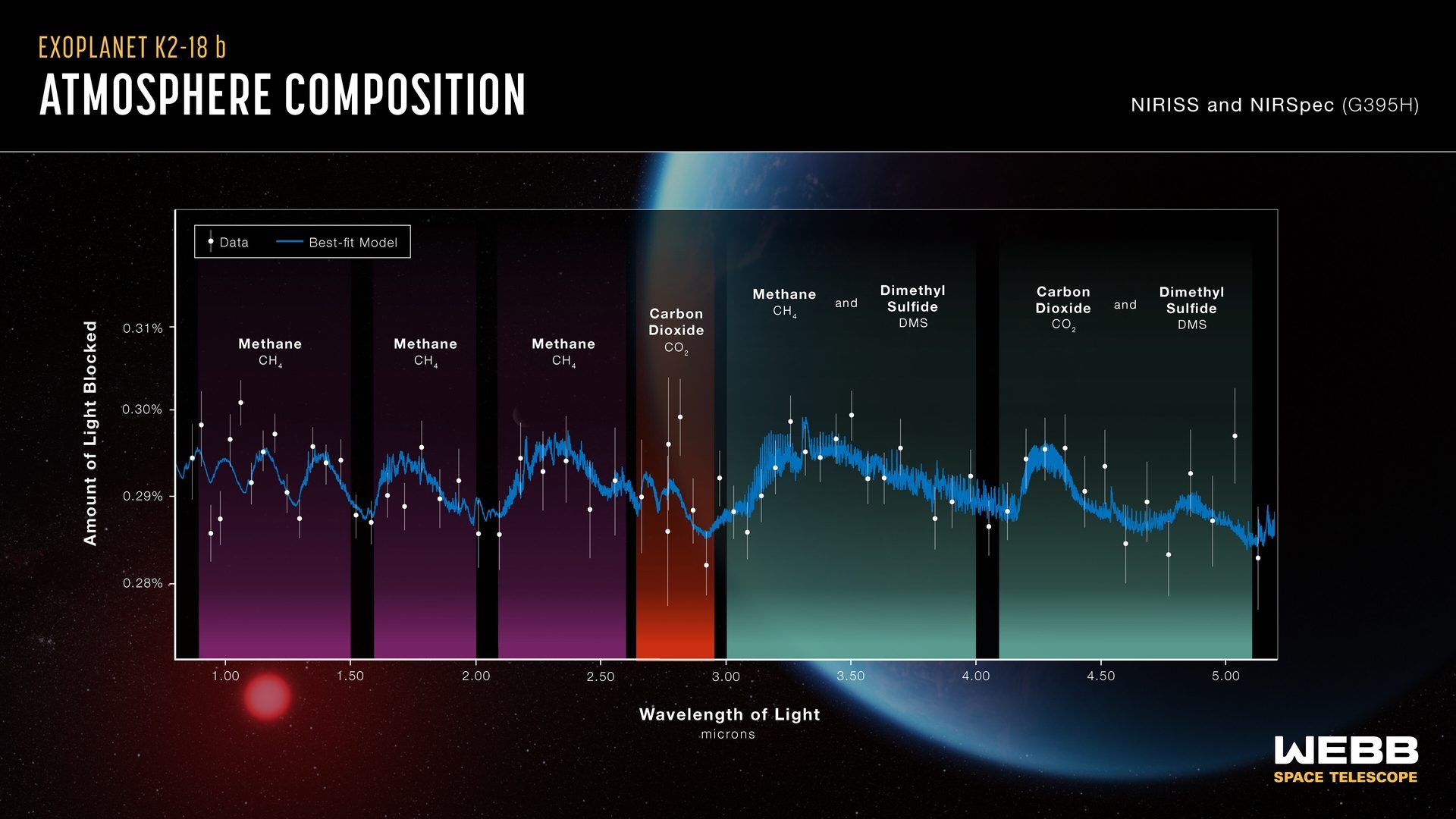
In September 2023, a study published in the Astrophysical Journal Letters by Professor Nikku Madhusudhan's team at the University of Cambridge sent shockwaves through the global scientific community — the James Webb Space Telescope had detected the signal of dimethyl sulfide (DMS, chemical formula (CH₃)₂S) in the atmosphere of K2-18b. On Earth, DMS is produced almost exclusively by marine phytoplankton and microorganisms, making it one of the most eagerly sought biosignatures in the search for extraterrestrial life.
What Is DMS?
Dimethyl sulfide is an organic sulfur-containing molecule and a key compound in Earth's biological sulfur cycle. In Earth's oceans, phytoplankton (such as coccolithophores and cyanobacteria) produce DMS from dimethylsulfoniopropionate (DMSP), possibly as an osmoregulatory or antioxidant defense mechanism. Every year, Earth's oceans release approximately 20 million tons of DMS gas into the atmosphere.
Why is DMS so significant? Because the biological production of DMS is one of Earth's oldest life processes, dating back billions of years. No known abiotic geological or chemical process produces DMS at significant levels in Earth's environment.
What JWST Saw
Madhusudhan's team used JWST's NIRSpec and MIRI instruments for their observations. Analyzing the transmission spectrum data, they found absorption features consistent with DMS at approximately 3.4 microns and 7.8 microns. These features remained significant after accounting for noise models, with a statistical confidence of about 3 sigma — meaning roughly 99.7% probability that the signal originates from DMS rather than random noise.
The team emphasized in their paper that while DMS is the best current explanation, other molecules cannot be entirely ruled out. Certain sulfur compounds, hydrocarbons, or carbon monoxide could produce similar spectral features under specific conditions. The team employed multiple analytical methods including forward modeling and retrieval algorithms.
What It Means
If the DMS signal is confirmed, it would represent the most significant step ever taken in the search for extraterrestrial life. But this does not mean we have directly discovered alien life. DMS is a potential biosignature — like "smoke" suggesting "fire," but smoke itself is not fire.
Scientists are actively investigating possible DMS production mechanisms on K2-18b. Unlike Earth, K2-18b has a hydrogen-rich atmosphere and may have a global liquid water ocean (consistent with the hycean model). In such an environment, microorganisms adapted to high CO₂, low oxygen, high pressure, and warm waters could potentially produce DMS similar to Earth's phytoplankton.
However, astrochemists are also exploring abiotic DMS production possibilities. Can ultraviolet radiation or lightning drive DMS production in a reducing atmosphere? Current theoretical chemical models suggest that abiotic production of detectable DMS levels around a red dwarf is challenging, increasing the credibility of DMS as a biological indicator.