📝 Editor's Note
Honestly, I really wish DMS turns out to be evidence of alien life. But science can't run on hope alone. Follow-up studies in 2024 suggested the signal might not be as strong as initially thought. Rationally, I know controversy is part of the process — but a part of me is still holding out hope.
— Admin
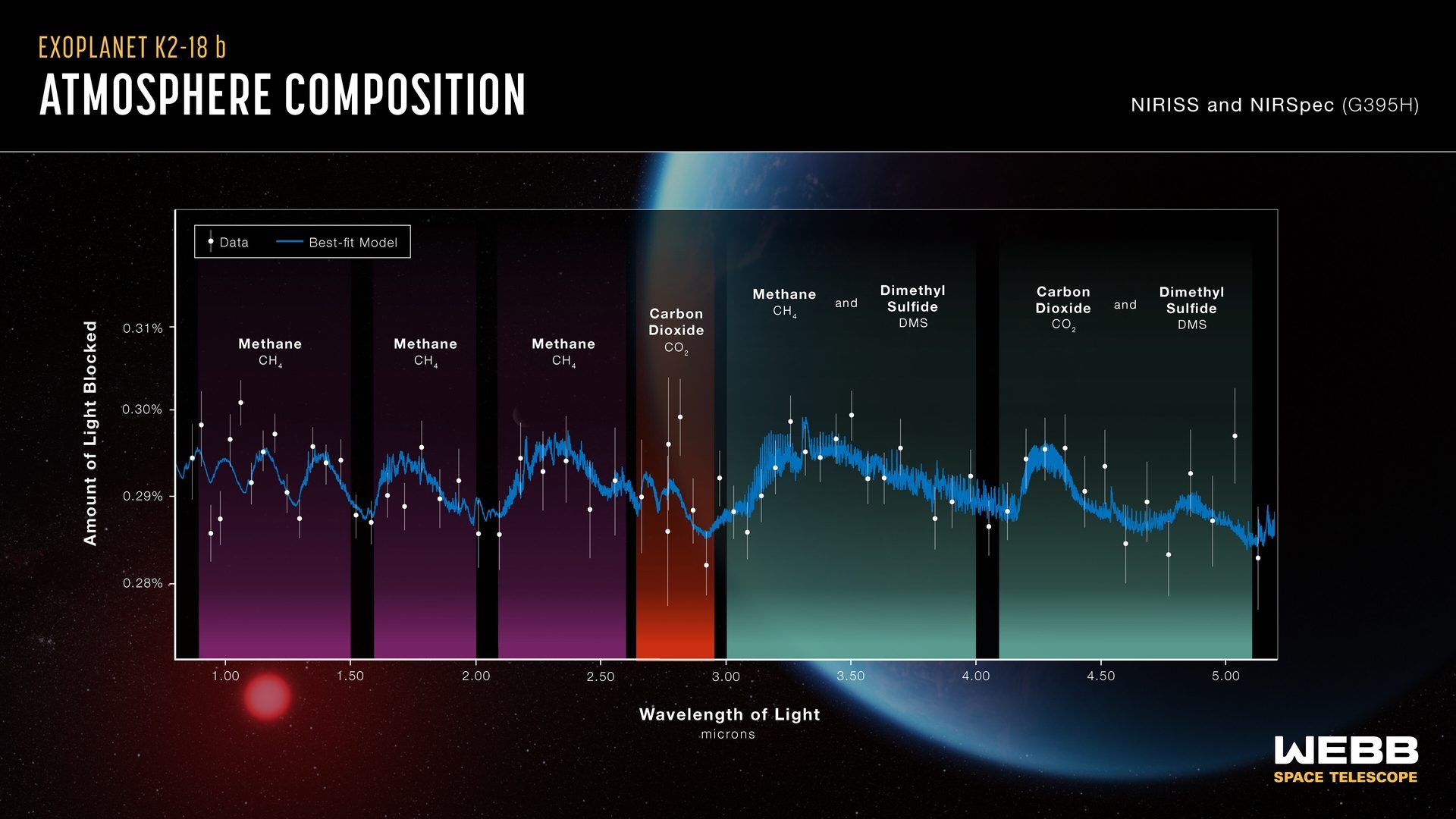
When the Madhusudhan team announced the detection of DMS in K2-18b's atmosphere in September 2023, the scientific community and public alike were electrified. Yet amid the excitement, rigorous scientists began examining the finding more deeply — how statistically significant is it? What are the possible abiotic explanations? How far are we from definitively confirming extraterrestrial life?
Statistical Significance
The initial DMS signal was reported at approximately 3 sigma confidence. In astrophysical standards, this is classified as "evidence for" rather than "confirmation of" a discovery. Particle physics typically requires 5 sigma for a discovery claim. For comparison, Hubble's 2019 water detection was at 3.6-4.0 sigma, making the DMS signal weaker by comparison.
What does 3 sigma mean? There is roughly a 0.3% chance the signal is due to random noise. However, in exoplanet atmospheric spectroscopy, the real challenges extend beyond random noise to systematic errors — stellar activity (starspots, flares), tiny instrument calibration deviations, and simplified atmospheric model assumptions. These systematic errors are difficult to address with pure statistical methods.
Exploring Abiotic Explanations
Astrochemists are actively investigating non-biological DMS formation pathways. On Earth, geothermal activity in extreme environments can cause sulfides to react with organic matter, producing small amounts of dimethyl sulfide. On a sub-Neptune like K2-18b, could active internal geology produce detectable DMS through similar processes?
Studies show that in hydrogen-rich reducing atmospheres, DMS photochemical degradation is relatively rapid — DMS molecules are broken down by UV radiation within days to weeks. Maintaining a detectable DMS concentration requires continuous production. If the production rate far exceeds reasonable abiotic limits, a biological source becomes the more plausible explanation.
Scientific Community Response
Following the paper's publication, multiple teams began independent verification efforts. Some attempted to reanalyze the same Webb data using different data processing pipelines. Others employed more complex atmospheric models incorporating aerosols, cloud inhomogeneity, and 3D circulation to reassess DMS signal credibility.
By 2024, preliminary independent results were not yet in agreement. Some analyses supported the DMS interpretation, while others suggested the signal could arise from combinations of other molecules (like ethane or formaldehyde) or represent a "coincidental" feature combination. This scientific uncertainty is not a weakness, but a normal part of the scientific process.
Copernican Caution
History's "Martian canals" controversy teaches us that humans tend to interpret unfamiliar phenomena in familiar terms. Carl Sagan's dictum "extraordinary claims require extraordinary evidence" remains science's golden standard.
Thus, the mainstream scientific attitude is: maintain an open mind while upholding rigorous standards. We need longer, broader JWST observations to confirm the DMS signal; precise laboratory measurements of DMS spectra at various temperatures and pressures; and more complete atmospheric chemical models. Only when all these puzzle pieces are in place can we make a responsible judgment.